As winter temperatures drop across Westmoreland County, your home heating system must transition from months of summer dormancy into non-stop, high-demand operation. At Greensburg Heating & Cooling, we deliver comprehensive, engineering-grade residential heater tune-ups designed to ensure your system fires reliably, safely, and at peak thermal efficiency from the very first cold night.
A genuine heating tune-up is not a quick 10-minute visual glance or a simple filter replacement. Our certified HVAC specialists perform a rigorous 26-point precision calibration. Using digital combustion flue gas analyzers, dual-port digital manometers, and electronic microamp meters, we calibrate gas manifold pressures, scrub burner assemblies, test high-limit safety controls, balance duct static pressure, and inspect heat exchangers for life-threatening carbon monoxide leaks.
Related Heating Navigation & Silo Services:
Setting the Industry Benchmark
In the heating industry, the phrase "tune-up" is often misused. Some budget contractors offer cheap promotional rates simply to get a foot in the door, spending less than 15 minutes in your basement performing a superficial visual glance, blowing dust off the cabinet, and pushing expensive unneeded replacement parts.
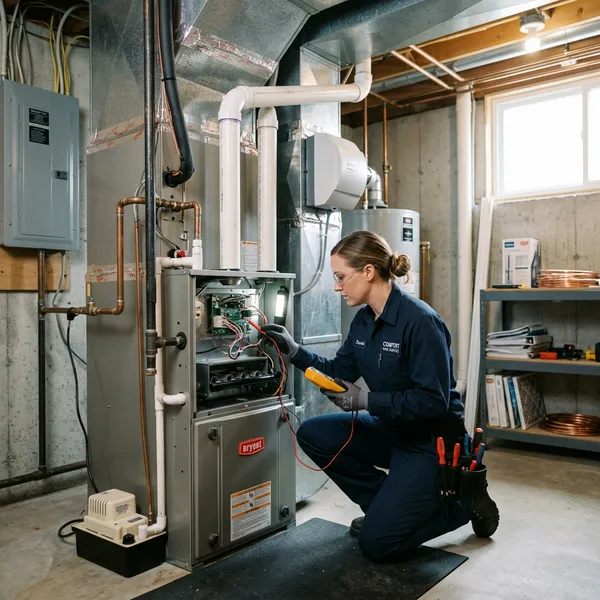
At Greensburg Heating & Cooling, our heating tune-up is a scientific mechanical restoration process. Our factory-certified technicians spend 60 to 90 minutes testing, measuring, and tuning every functional component against original factory manufacturer specifications.
We use digital combustion analyzers, high-precision dual-port manometers, and True-RMS multimeters. We measure gas pressures down to 0.01 inches water column and electrical capacitance to 0.1 microfarads, eliminating subjective guesswork.
We do not just look at the burner box. We unmount burner assemblies to clear inner orifice passages, pull flame sensors for precision cleaning, and inspect blower centrifugal vanes to remove restrictive dust blankets.
We insert high-definition micro-borescope cameras into every individual heat exchanger cell to detect micro-cracks before they leak carbon monoxide into your ductwork, testing high-limit switches under live operating conditions.
Our Comprehensive Checklist
Every residential heating tune-up completed by Greensburg Heating & Cooling follows our strict 26-point engineering procedure divided into five key mechanical categories:
Upon completion, our technician provides a complete digital report showing exact before-and-after readings for gas pressure, static pressure, flame sensor microamps, and combustion efficiency.
Service Tier Comparison
Not all heating tune-ups are created equal. Review how our comprehensive 26-point engineering calibration compares to a standard contractor checklist or a budget handyman visit:
| Diagnostic Inspection Feature | Budget Handyman Check | Standard Contractor Visit | Greensburg Precision Tune-Up |
|---|---|---|---|
| Appointment Duration | 10 to 15 minutes | 25 to 35 minutes | 60 to 90 minutes exhaustive service |
| Combustion Flue Gas Analysis | ✗ Not performed | Visual flame check only | ✓ Calibrated digital electronic test |
| Heat Exchanger Crack Inspection | ✗ External glance only | Flashlight visual check | ✓ High-resolution video borescope camera |
| Flame Sensor Microamp Testing | ✗ Not tested | Wiped with cloth if requested | ✓ Multimeter tested + emery polished |
| Gas Manifold Pressure Calibration | ✗ No manometer | ✗ Rarely checked | ✓ Dual-port digital manometer calibrated |
| Total External Static Pressure (TESP) | ✗ Not measured | ✗ Not measured | ✓ Supply and return probe tested |
| Condensate Drain & Acid Neutralizer | ✗ Ignored | Visual check of drain tube | ✓ Trap chemically flushed + media checked |
| Itemized Diagnostic Scorecard | ✗ None | Basic paper checklist | ✓ Comprehensive digital report provided |
The Takeaway: A cut-rate $49 tune-up that skips combustion analysis and static pressure testing leaves your family vulnerable to mid-winter breakdowns and carbon monoxide leaks. Invest in genuine engineering precision.
Book Your Precision Tune-UpMany homeowners hesitate to spend money on a tune-up when their heater appears to be functioning normally. However, thermal efficiency degradation is silent and cumulative. Review the mathematical financial return on investment delivered by a precision pre-season calibration in Greensburg:
A 10% to 15% efficiency boost across five months of heavy winter heating directly reduces your Peoples Gas or Columbia Gas invoices.
Catching an aging capacitor or dirty flame sensor during regular hours avoids emergency weekend diagnostic dispatch and overtime labor rates.
Extending equipment lifespan from 12 years to 20+ years saves thousands of dollars by delaying the capital cost of a new heating system.
Local Neighborhood Expertise
Greensburg diverse housing stock presents distinctive mechanical demands. Our technicians customize our tune-up process to the specific architectural requirements of your neighborhood:
Historic brick and masonry residences in Academy Hill frequently operate on converted gravity ductwork with stone foundation basements. Lime dust and basement moisture accelerate flame sensor oxidation and coat blower motor bearings.
Tune-Up Focus: Deep chemical burner cleaning, electrical bearing lubrication, and static pressure balancing to ensure gentle, continuous warm convective currents through thick uninsulated plaster walls.
Sprawling mid-century ranches and split-levels throughout Fort Allen and Saybrook suffer from static pressure drop across extended horizontal duct trunks. Perimeter bedrooms often stay cold while family rooms near the basement overheat.
Tune-Up Focus: TESP supply/return balancing, blower speed tap adjustment for optimal CFM delivery, and fine-tuning two-stage low-fire runtimes to eliminate temperature stratification.
Contemporary custom homes throughout Hempfield Township feature tight building envelopes and high-efficiency 96%+ condensing heaters. Mineral-rich water supplies cause secondary heat exchanger condensate traps to clog with acidic sludge.
Tune-Up Focus: Condensate P-trap chemical flushing, limestone acid neutralizer testing, outdoor direct-vent snow clearance inspection, and smart communicating thermostat staging calibration.
Scientific Testing Tolerances
At Greensburg Heating & Cooling, every tune-up involves taking accurate digital measurements with laboratory-grade instruments. We record exact electrical, pressure, and combustion readings before and after our adjustments to ensure your system meets strict factory engineering specifications:
| Mechanical / Electrical Component | Factory Nominal Specification | Degraded / Failing Threshold | Tune-Up Calibration Protocol |
|---|---|---|---|
| Flame Sensor Rectification Signal | 2.0 to 4.5 microamps (uA) DC | Under 1.2 uA DC (Intermittent lockout) | Emery cloth micro-abrasion to remove silica oxidation; sensor probe repositioning |
| Silicon Carbide Hot Surface Igniter | 45 to 90 ohms cold resistance | Exceeds 110 ohms (Imminent burnout) | Resistance recording; proactive replacement recommendation before cold snaps |
| Blower Motor Run Capacitor | Within ±5% of rated microfarads (uF) | Greater than 10% capacitance loss | Digital capacitance meter test; terminal cleaning and capacitor replacement |
| Natural Gas Manifold Pressure | 3.5 inches water column (±0.2 in. w.c.) | Under 3.0 in. w.c. or Over 3.8 in. w.c. | Dual-port digital manometer calibration; regulator diaphragm screw tuning |
| Total External Static Pressure (TESP) | 0.30 to 0.50 in. w.c. across heat exchanger | Exceeds 0.70 in. w.c. (High static choke) | Static probe testing; filter inspection, damper balancing, speed tap adjustment |
| Flue Gas Carbon Monoxide (CO) | Under 25 ppm (Air-free combustion) | Exceeds 50 to 100 ppm (Dangerous hazard) | Electronic flue gas analyzer sampling; burner de-carbonization; crack audit |
| Draft Inducer Negative Vacuum | -0.65 to -1.20 in. w.c. (Negative pull) | Drops below pressure switch rating | Clearing collector box condensate port, checking vent termination clearances |
| Supply-to-Return Temperature Rise | Within rating plate Delta-T (35°F - 65°F) | Exceeds 75°F (Overheating limit trip) | Blower CFM speed tap adjustment; cleaning secondary condensing coil vanes |
Mechanical Sequence of Operation
Understanding the mechanical sequence of operation helps explain why a precision tune-up is essential. When your thermostat calls for heat, your heating unit executes an intricate 10-stage choreography of electrical safety handshakes and gas combustion steps:
The thermostat senses indoor room temperature dropping below setpoint and energizes the 24V AC heating circuit (closing R to W). During our tune-up, we test control board terminal voltage and cycle-rate programming.
The control board powers the draft inducer fan, establishing draft and purging unburned residual gases from the heat exchanger cells. We measure inducer motor running amperage and check for bearing rumble.
The differential draft pressure switch closes, confirming negative vacuum pressure and clear venting. We test the switch with a digital manometer to ensure it trips at exact manufacturer pressure thresholds.
The silicon carbide or nitride igniter energizes for 15 to 45 seconds, glowing white-hot (1,800°F - 2,500°F). We measure igniter electrical resistance to prevent brittle cold-weather ignition failures.
The dual-stage automatic gas valve opens, releasing natural gas through precision brass orifices into the primary burners. We inspect flame crossover carryover tubes to ensure instantaneous, quiet ignition.
The flame sensor detects the burner flame by rectifying AC current into DC microamps. If this signal drops below 1.5 uA, the board shuts the gas valve immediately. We polish the sensor to maintain a strong 3.0+ uA signal.
The main circulation blower delays startup for 30 to 60 seconds while the heat exchanger warms up, preventing blasts of cold air from supply registers. We test blower relay switching and motor startup torque.
Throughout the heating run, the integrated control board monitors high-limit temperature sensors and roll-out switches. If plenum airflow is choked by a dirty filter, the limit trips safely before metal cracks.
When room temperature reaches setpoint, the gas valve de-energizes instantly. The draft inducer continues running for a 15 to 30 second post-purge cycle to expel combustion byproducts out the flue vent.
The blower motor runs for 90 to 180 seconds after flame extinction, scavenging remaining sensible heat from the heat exchanger and delivering it into your home, boosting overall seasonal AFUE efficiency.
Real Local Solutions
Review three actual service scenarios resolved during pre-season tune-ups across Greensburg and Hempfield Township neighborhoods:
A homeowner in a historic 1920s brick home reported a loud popping sound every time their heater started. Our technician found heavy lime dust and spider webbing obstructing the burner crossover carryover channel. Gas was pooling for 6 seconds before violently igniting.
Tune-Up Resolution: Complete chemical disassembly and cleaning of burner ports, manifold gas pressure calibrated to 3.5 in. w.c., restoring instant whisper-quiet ignition and protecting the heat exchanger from explosive shock.
A ranch-style home in Fort Allen suffered from random heating shutdowns on bitter evenings. The homeowner assumed the thermostat was defective. Our static pressure audit revealed Total External Static Pressure (TESP) was choked at 0.88 in. w.c. due to an undersized filter and coated blower wheel vanes.
Tune-Up Resolution: Blower wheel deep-cleaned, static pressure lowered to 0.46 in. w.c., and high-limit safety cycling eliminated, restoring continuous balanced airflow to cold outer bedrooms.
In a suburban Hempfield residence, a 96% high-efficiency condensing heater was short-cycling and producing a gurgling sound in the exhaust. The internal condensate collection P-trap was packed with mineral sludge, backing up acidic water into the secondary heat exchanger.
Tune-Up Resolution: Chemically flushed condensate traps, verified 1/4 inch per foot flue pipe pitch, and replenished the limestone neutralizer cartridge, preventing thousands in secondary coil corrosion damage.
Preparation Guide
To help our technicians conduct the most thorough and efficient inspection possible, we recommend Greensburg homeowners follow these simple pre-arrival preparation steps:
Move storage bins, paint cans, laundry baskets, and furniture at least 3 feet away from your basement heating unit and electrical service switch.
Ensure drapes, area rugs, and sofas are not obstructing floor supply registers or wall return air grilles in any room.
Make a mental note of any cold rooms, strange squeaking sounds, or burner smells noticed during the previous winter to share with our lead tech.
Keep family dogs and cats in a comfortable room away from basement staircases while technicians carry testing equipment and open entry doors.
Based on 123+ local reviews
"Caleb performed a thorough check of my furnaces in Greensburg. I always trust the work this team and their technicians do. Arrived right on time and explained everything clearly."
"I was very satisfied and pleased with all the work done by Caleb and Brett. I needed a large variety of heating jobs done and each one was completed cleanly without any mess."
"They were able to get us in fast even though it was really hot outside and they were extremely busy. Great job! I would definitely use them again for our residential cooling needs."
Clear, upfront answers to common questions about residential HVAC service, pricing, and emergency response in Greensburg, PA.
Our local technicians are based directly in Greensburg, PA, allowing us to arrive at your doorstep swiftly for scheduled maintenance and 24/7 heating or cooling emergencies.
Greensburg
PA 15601
South Greensburg
PA 15601
Southwest Greensburg
PA 15601
Jeannette
PA 15644
Irwin
PA 15642
North Huntingdon
PA 15642
Murrysville
PA 15668
Delmont
PA 15626
Penn Township
PA 15644
Latrobe
PA 15650
Hempfield Township
PA 15601
Youngwood
PA 15697
Call our Greensburg dispatch office to verify immediate technician availability in your neighborhood.
Do not wait for the first freezing winter storm to discover your heater is malfunctioning. Contact Greensburg Heating & Cooling today to schedule your comprehensive 26-point seasonal tune-up. We provide convenient scheduling, punctual service, and honest flat-rate pricing.
Want immediate scheduling confirmation? Call our local Greensburg office to lock in your tune-up window.
📞 Call (724) 482-3710Complete the brief form below and our certified heating specialist will confirm your seasonal maintenance time slot.
Centrally located on S Pennsylvania Ave, our mobile service trucks are dispatched directly across Greensburg, Hempfield Township, South Greensburg, and throughout Westmoreland County.
140 S Pennsylvania Ave, Greensburg, PA 15601, USA
Call: (724) 482-3710
24/7/365 Emergency Dispatch Ready
Our certified HVAC specialists are on standby 24 hours a day to restore comfort to your home. Fast diagnostics, upfront quotes, and zero hassle.