When bitter winter winds whip across Westmoreland County and your home heating system abruptly halts, you need an experienced local technician at your doorstep fast. Greensburg Heating & Cooling provides prompt, 24/7 emergency residential heater repair across Greensburg, South Greensburg, and Hempfield Township. From diagnosing frozen pilot assemblies and faulty flame sensors to replacing seized blower motors and cracked hot surface igniters, our EPA-certified specialists arrive in fully equipped service vans to restore dependable heat on the very first visit.
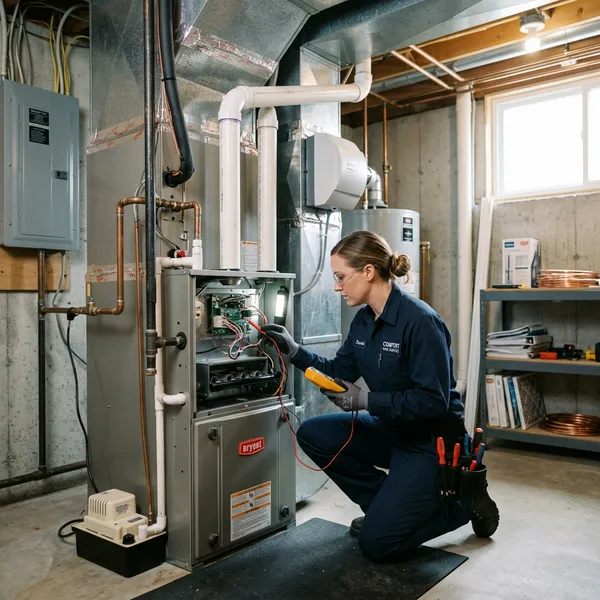
EPA-Certified, Background-Checked Residential Heating Specialists
Before requesting emergency dispatch, performing these six quick safety checks can sometimes resolve minor issues or help our technicians diagnose the problem faster upon arrival.
Verify the thermostat mode is set to HEAT and the fan is set to AUTO. Raise the setpoint at least 5 degrees above current room temperature to call for heat. Replace AA/AAA batteries if display is blank.
Locate the red emergency toggle switch (often installed at the top of the basement stairs or directly on the furnace casing). Make sure it was not accidentally switched OFF.
Check your home main electrical breaker box. Look for the breaker labeled FURNACE or HEATER. If tripped into the center position, flip firmly OFF then back ON once.
A dust-choked 1-inch or 4-inch filter chokes return airflow. Within minutes, the internal heat exchanger overheats, tripping the high-temperature safety limit switch and shutting down the burners.
High-efficiency condensing heaters vent out the side of your home via white PVC pipes. During heavy Westmoreland County snowdrifts, snow or ice blockages trip pressure switches, halting operation.
Inspect the yellow or black manual gas shutoff valve along the iron supply pipe feeding the heater. The lever must be parallel to the pipe to allow fuel delivery. If perpendicular, it is closed.
Residential heating systems are complex mechanical assemblies governed by sensitive electronic safety sensors. When a single component malfunctions, the entire system enters a safety lockout to prevent fire, gas leaks, or carbon monoxide accumulation.
Silicon carbide or silicon nitride elements that glow red-hot to ignite gas burners. Constant thermal expansion causes hairline fractures, resulting in open circuits and zero ignition.
A small metal rod sitting in the burner flame that sends a micro-amp electrical signal to the control board. Carbon soot build-up blocks the signal, shutting burners down within seconds.
The small exhaust motor that draws toxic combustion gases through the heat exchanger and vents them outdoors. Bearing seizure or wheel cracks trip the safety pressure switch.
The primary motor pushing conditioned warm air through ductwork. Symptoms of failure include failing run capacitors, locked bearings, screeching squeals, or failed variable-speed control heads.
Bi-metal safety sensors monitoring internal supply plenum heat. If restricted airflow drives temperatures above safety limits, this switch opens to cut gas delivery and prevent fires.
The dual-stage solenoid valve regulating fuel pressure entering the burner manifold. Faulty magnetic coils or internal diaphragm stiffness can starve the heater of fuel.
The electronic brain coordinating ignition timing, blower delays, safety limit inputs, and thermostat signals. Voltage surges, cracked solder joints, and welded relays mandate replacement.
For boiler systems, circulator pumps and 24V motorized zone valves govern hot water circulation to radiators. Stuck valves or burned pump motor seals lead to cold zones.
Identify the exact malfunction your heating system is exhibiting below to understand the mechanical cause and our proven repair procedure.
The Problem: The heater turns on, ignites properly, and warms up, but abruptly cuts out before reaching the thermostat setpoint. It waits several minutes, then repeats the process endlessly.
The Technical Cause: The high-temperature primary limit switch is opening because internal heat cannot escape fast enough. This is usually triggered by a clogged air filter, blocked supply dampers, a failing blower motor running at reduced RPM, or severe static pressure restrictions in undersized ductwork.
Our Solution: We measure total external static pressure (TESP) with digital manometers, test limit switch calibration, replace restricted filters, and inspect the blower wheel for dust loading.
The Problem: The furnace or air handler blower fan runs indefinitely, circulating cool or room-temperature air through the rooms without any heat generation.
The Technical Cause: The control board has initiated an ignition lockout. If the unit attempts ignition three consecutive times and either fails to light or drops the flame signal, the control board halts gas flow to prevent dangerous gas pooling, but runs the blower fan to dissipate residual heat.
Our Solution: Our technicians read the flashing LED diagnostic error code on the control board, inspect and polish the flame sensor, check hot surface igniter voltage, and verify proper gas supply pressure.
The Problem: Whenever the heating cycle starts and the blower turns on, a harsh screeching noise echoes through the floor vents across your home.
The Technical Cause: The bearings inside the direct-drive blower motor or the draft inducer fan have dried out, degraded, or seized. Friction creates intense heat, leading to complete motor seizure if left unaddressed.
Our Solution: We check motor shaft play, verify electrical amperage under load, and replace failing blower motors with factory OEM components or high-efficiency ECM motors.
The Problem: When the thermostat calls for heat, you hear the normal startup click, followed seconds later by a startlingly loud boom or thud from the basement.
The Technical Cause: Delayed ignition. Dirty gas burners, corroded burner ports, or improper gas manifold pressure prevent gas from lighting instantly at the first burner. Unburned gas accumulates inside the combustion chamber before suddenly detonating all at once.
Our Solution: We disassemble the burner rack, chemically descale and clean all burner cross-over ports, calibrate manifold pressure, and inspect the heat exchanger for stress fractures.
The Problem: A persistent electrical or chemical burning smell blows from vents, distinct from the temporary dusty smell typical during the very first autumn startup.
The Technical Cause: Overheating electrical wire harnesses, melting insulation, failing blower motor windings, or foreign debris drawn into the blower fan housing contacting electrical heating elements.
Our Solution: We immediately inspect electrical junctions with thermal imaging cameras, measure motor amperage draws, and replace compromised wiring harnesses to prevent electrical fires.
The Problem: Puddles of water accumulate on the basement floor beneath a 90%+ AFUE gas furnace or condensing boiler, threatening to rust out the cabinet and short out lower wiring.
The Technical Cause: High-efficiency heaters produce acidic water as part of the condensing combustion process. When internal condensate traps, vinyl drain tubes, or condensate pump check valves clog with bacterial algae or mineral scale, water backs up and overflows.
Our Solution: We chemically flush internal condensate traps, descale drain lines, replace stuck condensate pumps, and inspect PVC flue unions for proper solvent weld seal integrity.
The Problem: In older Greensburg homes with hydronic radiator heating, first-floor radiators heat up normally, but second and third-floor radiators remain stone cold.
The Technical Cause: Air pockets have migrated to the highest point in the closed-loop system, creating an air-lock that blocks hot water flow. Alternatively, the upstairs zone valve motor has failed, or boiler system pressure has dropped below the 12 to 15 PSI required to lift water to upper stories.
Our Solution: We test boiler fill valves, bleed air from radiator coin vents, test zone valve end-switches, and verify expansion tank diaphragm pressure.
The Problem: When the thermostat calls for heat, you hear rapid, repeated clicking sounds from inside the heating unit, but burners never light up and the system soon goes silent.
The Technical Cause: On spark-ignition models, the spark module is arcing, but the 24V gas valve solenoid is failing to open due to burned coils or low voltage from the transformer. On hot surface igniter models, an ignition relay on the control board may be chattering due to a loose ground connection.
Our Solution: We trace 24VAC control circuit voltage from the transformer to the gas valve, test gas coil resistance, verify electrical grounding, and replace failing ignition modules.
We operate with 100% transparency. Our technician conducts a full physical diagnostic, identifies the exact problem, and gives you a clear written quote before touching a tool. Zero hidden travel fees, zero bait-and-switch tactics.
| Repair Category | Common Components Included | Estimated Cost Range | Warranty Coverage |
|---|---|---|---|
| Full System Diagnostic | Multimeter electrical check, gas pressure test, safety switch test | $89 to $129 | Applied toward repair |
| Basic Electrical & Sensors | Flame sensor cleaning/swap, blower capacitor, hot surface igniter | $150 to $350 | 1-Year Parts & Labor |
| Safety Switches & Valves | Primary high limit switch, rollout switch, 24V electronic gas valve | $350 to $650 | 1-Year Parts & Labor |
| Combustion & Exhaust Motors | Draft inducer motor assembly, pressure switch, flue pipe repair | $450 to $850 | 1-Year Parts & Labor |
| Major Core Assemblies | Variable-speed ECM blower motor, integrated control board, circulator | $750 to $1,400 | 1-Year Parts & Labor |
We believe you shouldn't be penalized for an HVAC breakdown that happens outside of 9-to-5 business hours. We charge the exact same flat-rate fee 24/7.
If your heater requires a major component replacement and is over 12 to 15 years old, pouring costly repair money into an obsolete system can quickly turn into a financial money pit. We help you make an objective, numbers-based decision using the HVAC Industry Rule of $5,000.
Age of System (Years) × Estimated Repair Cost ($)
When replacement is the better path, we provide turn-key installation options with local utility rebates through Peoples Natural Gas, Columbia Gas, and Federal 25C tax credits up to $600.
Greensburg terrain and architectural variety create specific heating challenges that generic HVAC contractors frequently misdiagnose. Our technicians understand the nuances of local Westmoreland County homes.
Older homes often feature high-mass hydronic boiler systems. We repair leaking circulator flanges, failed 24V Honeywell zone valves, and airbound radiator loops that leave top-floor master bedrooms cold.
Mid-century ranches frequently route heating ductwork through unconditioned crawlspaces. We repair rusted metal plenums, frozen condensate drains, and overheated limit switches caused by choked crawlspace return grilles.
In Fort Allen, Bovard, and Carbon, larger two-story colonials often experience static airflow imbalance. We repair failed ECM blower motors, re-program digital zone control panels, and replace cracked pressure switches.
If your carbon monoxide alarm sounds or family members experience unexplained headaches, dizziness, or nausea during winter:
Stationed at 140 S Pennsylvania Ave, Greensburg, PA 15601. Our service trucks are dispatched directly from the city center for rapid arrival.
Every service call follows our rigorous technical workflow to ensure that the root cause of your heating failure is permanently fixed.
Our local service van departs promptly from S Pennsylvania Ave, arriving in 30 to 60 minutes with full diagnostic gear and universal replacement parts.
We isolate electrical continuity, test motor capacitors, check gas manifold pressure with manometers, and test safety limit switches.
We review the exact failure with you and present an itemized written quote. You authorize the work before any repairs begin.
We install factory-authorized OEM components designed specifically for your system to preserve existing manufacturer warranties.
We test combustion flue drafting, perform an electronic carbon monoxide sniff test, and verify that safety shutoffs engage properly.
We cycle the heater through a complete heating cycle, demonstrate thermostat operation, and issue written 1-year warranty coverage.
Factory-Authorized Replacement Parts for All Residential Heating Brands
Based on 123+ local reviews
"Caleb performed a thorough check of my furnaces in Greensburg. I always trust the work this team and their technicians do. Arrived right on time and explained everything clearly."
"I was very satisfied and pleased with all the work done by Caleb and Brett. I needed a large variety of heating jobs done and each one was completed cleanly without any mess."
"They were able to get us in fast even though it was really hot outside and they were extremely busy. Great job! I would definitely use them again for our residential cooling needs."
Answers to common questions about residential emergency heater repair, diagnostic processes, and pricing in Greensburg, PA.
Our certified HVAC specialists are on standby 24 hours a day to restore comfort to your home. Fast diagnostics, upfront quotes, and zero hassle.
Our local technicians are based directly in Greensburg, PA, allowing us to arrive at your doorstep swiftly for scheduled maintenance and 24/7 heating or cooling emergencies.
Greensburg
PA 15601
South Greensburg
PA 15601
Southwest Greensburg
PA 15601
Jeannette
PA 15644
Irwin
PA 15642
North Huntingdon
PA 15642
Murrysville
PA 15668
Delmont
PA 15626
Penn Township
PA 15644
Latrobe
PA 15650
Hempfield Township
PA 15601
Youngwood
PA 15697
Call our Greensburg dispatch office to verify immediate technician availability in your neighborhood.
Fill out the dispatch form below or call our 24/7 hotline directly at (724) 482-3710.
Centrally located on S Pennsylvania Ave, our mobile service trucks are dispatched directly across Greensburg, Hempfield Township, South Greensburg, and throughout Westmoreland County.
140 S Pennsylvania Ave, Greensburg, PA 15601, USA
Call: (724) 482-3710
24/7/365 Emergency Dispatch Ready